The morning I found the garage empty, my son just looked down and said: “I sold it to pay for my honeymoon.” Then a restorer called and whispered: “Ma’am, your husband left something hidden in the dashboard. You need to come alone.”
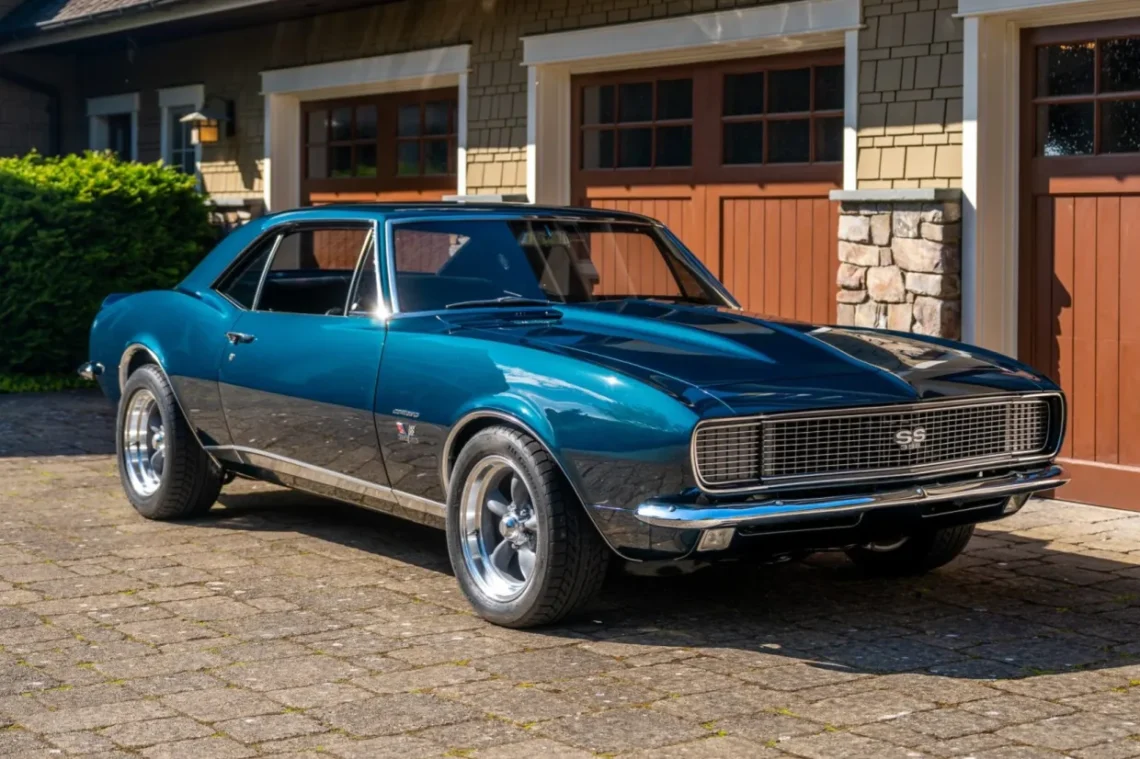
Tony’s shop smelled of new leather, varnish, and polished metal — a living memory. He left me alone behind the wheel of the navy blue Chevrolet with a brown envelope on my lap and a small wooden box wedged beside me. George always said that cars have a memory. That a well-cared-for car holds the hands of the person who touches it, the patience of the one who builds it. I used to tease him about it. He would laugh, wipe grease on an old rag, and say that some men need to build with bolts what they don’t know how to say with words. Sitting there with the dashboard open and a secret breathing down my neck, I understood he was right.
The envelope had my name in George’s slanted handwriting: For Olivia. Only if I’m gone. I opened the wooden box first. Inside was a black USB flash drive. And a ring — not George’s wedding band, which I buried with him. This was thicker, antique gold, with an engraving inside. R. M. / 1983. Ryan Mitchell. My son. The ring George had made for him at college graduation. Ryan wore it for two weeks, said it wasn’t his style, left it on a bathroom shelf. George never held it against him, but I had seen how it hurt. Why was it here, next to a flash drive?
I unfolded the letter. It was short. That hurt more than a long one would have — George always wrote long letters for important things. Short meant fear, or time running out. Olivia: If you are reading this, it’s because I ran out of time or didn’t have the courage to tell you to your face. I hope you forgive me for either one. Do not trust Frederick. And do not fully trust Ryan until you know what role he chose to play. I write it this way because I still want to believe our son can back out. But if he doesn’t, I need you to know that the Chevrolet isn’t just a car.
The next page explained: eleven months ago, he had discovered that Frederick — George’s business partner of twenty-seven years — was using a company account to funnel money through phantom suppliers. Forged signatures. Inflated invoices. An attempt to use the shop expansion as collateral for a debt George had never authorized. He hadn’t reported it yet because he was still gathering evidence and because he wanted to see what Ryan would choose.
The third page was the one that took the air from the room. I didn’t catch Ryan stealing. I wish it had been that simple. I caught him staying quiet. I caught him taking calls from Frederick. I caught him delivering papers “on errand.” And one afternoon, thinking I wasn’t looking, I caught him showing the garage to Melissa like someone showing off a future investment. I moved on to the next line: I found Ryan’s ring on the workbench next to a copy of the garage key and a note from Melissa that said: “if you convince your mom, even better.” I don’t know if she meant selling the car, moving me out of the house, or something worse. But that day I understood they weren’t waiting for time to pass. They were pushing it.
Suddenly too many small things fell into place. Ryan’s renewed interest in the house after George’s death. His questions about the deeds. Melissa walking through the garage as if measuring for patio furniture. The way he had sold the Chevrolet without hesitation, without remorse, the morning I found it gone. It wasn’t grief and careless youth. It was calculation. The last page was the shortest: If Ryan tells you he sold the car out of necessity, look at his hands. When he lies out of guilt, he touches his left thumb. When he lies with conviction, he won’t look you in the eye. If he does the latter, protect yourself first and try to understand him later.
On the back of the photograph of Ryan, Melissa, and Frederick standing together at the garage — looking like accomplices sharing a joke — I found a phone number. Attorney Eleanor Vance. I called her from the shop. Her assistant answered. I gave my name. Then Eleanor came on the line: firm, clear, unadorned. “Mrs. Mitchell. I’m so sorry about George. He spoke to me twice in the last three months. He left very specific instructions in case you showed up with certain documentation.” She told me not to go home, not to call Ryan, not to plug the flash drive into any uncontrolled computer. She gave me an address in Plano. “I’ll have a trusted associate waiting for you with secure equipment. Can you leave right now?” She didn’t ask if I was ready. She spoke like someone who knows time has already started moving in another direction. Tony was already grabbing his keys.
Halfway to Plano, my phone rang. Ryan. Too casual, too rehearsed. “Hey, Mom. I just wanted to see if you were feeling calmer.” Calmer. As if the car were a domestic misunderstanding. “I’m driving,” I said. “Who do I talk to first — you or Frederick?” Silence so abrupt that Tony gripped the steering wheel tighter. Ryan hadn’t asked what I was talking about. He defended himself instead. “I don’t know why you’re bringing Frederick into this. He just helped me find a buyer, that’s all.” I heard it clearly — too fast, too ready, no confusion. I told him I saw and hung up. Tony said quietly: “He knows.” “Yes.” “But not how much.” That was the only advantage still left to me.
Eleanor’s satellite office had thick curtains, an offline computer, and the smell of a place designed for people who arrive carrying things that could change too many lives. She read George’s letters standing up. Halfway through the second page she let out a long breath. Then she looked at me: “George wasn’t being paranoid. He hid this because the conflict wasn’t just with your son.” The tech opened the flash drive on a clean machine. Three folders: PROPERTIES. SUPPLIERS. RYAN. Eleanor opened the last one first. Inside were photographs, bank statements, and audio files. One document was titled “Bridge loan / informal request / cross-collateral.” Ryan’s name. Melissa’s. And a reference to a property identified as “Mitchell primary residence / future owner via expected succession.” They had used my house as collateral for a private debt without owning it, without my signature, without me knowing I had been counted as a future asset.
Another folder held printed conversation fragments between Ryan and Frederick. Ryan: If I convince her to sell the car, will you advance me the down payment? Frederick: First I need to know if the old man locked down the shop stuff. Ryan: My mom doesn’t understand that. She’ll get distracted with the honeymoon. She’ll get distracted with the honeymoon. They weren’t talking about me as a person. They were talking about me as a variable. Eleanor’s voice was steady when she told me the rest: George had discovered Frederick was draining money from the restoration business for two years — phantom suppliers, double billing, inflated repairs. George had started gathering evidence. Then he died. She held my gaze when she said the word yes, and added nothing else. The idea sat among us all in the room without anyone speaking it aloud.
“What do we do?” I asked. Eleanor didn’t hesitate. Secure copies. Block business transactions with a preventative order. Summon Frederick under a legal pretext before he knows what we have. Decide what you’re going to do with your son. That last part — not “we” but “you.” The legal problem had a clear path. The other one didn’t. I thought of Ryan asleep on the shop sofa as a small boy, hands stained with paint because he wanted to help his dad. Then I thought of the line from the message. She’ll get distracted with the honeymoon. Sometimes a single sentence is enough to change the shape of love.
At 5:12, Ryan called again. Too calm. “Frederick wants to talk to you. He says this can all be cleared up.” He hadn’t asked where I was. Hadn’t asked if I was okay. They were already doing damage control. “How kind,” I said. “And since when does Frederick decide what I need to clear up?” Silence. Then, lower: “Mom, please. You don’t understand how things are.” How things are — not what happened. As if I had stuck my hand into machinery he already knew about and he was afraid of losing fingers pulling it out. “Then explain them to me,” I said. A long breath. Then, for the first time since the morning of the empty garage, Ryan sounded genuinely terrified. “Not over the phone.” Eleanor slid me a paper: a restaurant in Plano, private room, own cameras, 8 p.m. I read it and nodded. “Tell Frederick I’ll see him today. And bring the keys to the garage. The copies, Ryan. All of them.” The line went silent. “What?” I hung up. Eleanor said quietly: “He does know more than he lets on.” “I know.”
I looked at the wooden box. The ring was still inside, motionless. Not evidence of the fraud. Evidence of the exact moment a father realized his son had started looking at the house from the outside. I didn’t know what would happen at that dinner. I didn’t know if Ryan would defend himself, beg, negotiate, or sink himself further. I didn’t know if Frederick would arrive smiling, offended, or dangerous. I only knew one thing: the blue Chevrolet hadn’t disappeared from my garage to pay for a honeymoon. It had left carrying a hidden secret for which someone — perhaps my son — had already started selling himself long before anyone thought to look inside the dashboard.